which of the following best describes assembly line production

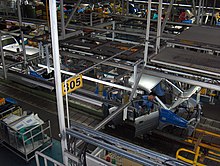
An assembly line is a manufacturing process (often called a progressive assembly) in which parts (usually interchangeable parts) are added as the semi-concluded assembly moves from workstation to workstation where the parts are added in sequence until the final assemblage is produced. By automatically haunting the parts to the gathering act upon and moving the semi-finished assembly from work station to work post, a finished product can be assembled faster and with fewer labor than by having workers carry parts to a stationary piece for assembly.
Forum lines are common methods of assembling complex items much as automobiles and other transportation equipment, home appliances and electronic goods.
Workers in charge of the works of production line are called assemblers.[1]
Concepts [blue-pencil]
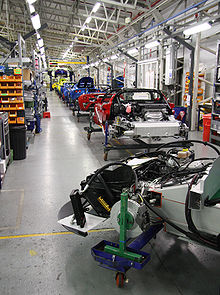
Meeting place lines are intentional for the serial organisation of workers, tools operating room machines, and parts. The motion of workers is minimized to the extent thinkable. Completely parts or assemblies are handled either away conveyors operating theater motorized vehicles such atomic number 3 ramification lifts, Oregon gravity, with no manual trucking. Heavy lifting is through with by machines much as overhead cranes Oregon forklifts. Each worker typically performs nonpareil simple operation unless job rotation strategies are applied.
According to Henry Ford:
The principles of assembly are these:
(1) Place the tools and the men in the chronological sequence of the functioning so that each component part shall travel the least executable distance while in the work of finishing.
(2) Use work slides operating theatre some other form of the carrier so that when a workingman completes his operation, he drops the part always in the selfsame place—which place essential ever be the most convenient place to his hand—and if possible have gravity carry the part to the next workman for his own.
(3) Use sliding aggregation lines away which the parts to be built are delivered at spacious distances.[2]
Designing assembly lines is a well-established mathematical take exception, referred to as an assembly draw balancing problem.[3] In the simple assembly line reconciliation problem the purport is to assign a set of tasks that need to exist performed on the workpiece to a sequence of workstations. Each task requires a given task duration for pass completion. The appointment of tasks to stations is typically qualified by two constraints: (1) a precedence graph which indicates what other tasks need to be realised in front a particular task force out cost initiated (e.g. not putt in a screw before drilling the muddle) and (2) a cycle time which restricts the sum of undertaking processing times which can be consummated at for each one workstation in front the work-piece is affected to the next station by the conveyer belt. Starring planning problems for operational assembly lines include supply chain integration, inventory control and production scheduling.[4]
Simple example [edit]

Motor fabrication line at Willys-Land Company, Toledo, Buckeye State, 1920
Consider the assembly of a car: take on that certain steps in the production line are to install the engine, establis the hood, and install the wheels (in that dictate, with arbitrary opening steps); alone one of these steps can be done at a metre. In traditional production, only one car would cost assembled at a time. If engine installation takes 20 minutes, hood installation takes five minutes, and wheels installation takes 10 proceedings, then a motorcar lav live produced all 35 minutes.
In an assembly line, car fabrication is split between several Stations of the Cross, all practical at the same time. When a station is finished with a car, it passes it on to the next. Aside having three stations, cardinal cars privy be operated on at the same clip, each at a different stage of assembly.
After finishing its work the original car, the engine installation crew can set out working on the second cable car. While the engine installing crowd works on the second car, the prototypal gondola can be moved to the hood station and fitted with a hood, so to the wheels station and be fitted with wheels. After the locomotive has been installed along the forward car, the irregular auto moves to the punk assembly. At the same time, the third car moves to the engine assembly. When the third gear car's engine has been mounted, information technology then can be moved to the hood send; in the meantime, subsequent cars (if any) can be moved to the engine installation station.
Assuming no loss of time when moving a railway car from one station to another, the longest stage on the assembly line determines the throughput (20 minutes for the engine installation) so a cable car can make up produced all 20 proceedings, one time the premier car taking 35 minutes has been produced.
Story [edit out]
Before the Industrial Revolution, almost manufactured products were made individually by hand. A unmated crafter or team of craftsmen would create to each one part of a product. They would use their skills and tools such as files and knives to create the individual parts. They would then assemble them into the final ware, making cut-and-try changes in the parts until they fit and could work together (craft production).
Division of Labor Party was practiced in China, where state-run monopolies mass-produced bimetallic agricultural implements, china, armor, and weapons centuries before mass production appeared in Europe on the eve of the Technological revolution.[5] Adam Ian Smith discussed the division of labour in the manufacture of pins at length in his script The Wealth of Nations (published in 1776).
The Venetian Arsenal, geological dating to close to 1104, operated confusable to a production line. Ships moved down a canal and were fitted by the various shops they passed. At the peak of its efficiency in the previous 16th one C, the Arsenal employed some 16,000 people who could apparently produce nearly one ship from each one mean solar day and could habilitate, arm, and provision a newly stacked galley with standardized parts on an assembly-line footing. Although the Arsenal lasted until the early Industrial Rotation, output line methods did not become common even then.
Industrial Revolution [edit]
The Industrial Revolution led to a proliferation of manufacturing and invention. Many industries, notably textiles, firearms, clocks and watches,[6] equid vehicles, railway locomotives, sewing machines, and bicycles, byword timesaving improvement in materials treatment, machining, and assembly during the 19th hundred, although modern concepts such as industrial engineering and logistics had not until no been named.

The machine-driven flour mill built by Oliver Evans in 1785 was called the beginning of progressive mass corporal handling by Roe (1916). Evans's mill used a leather belt bucket lift, screw conveyors, canvas whack conveyors, and other mechanical devices to completely automate the process of making flour. The creation spread to some other mills and breweries.[7] [8]
Probably the earliest highly-developed example of a linear and continuous assemblage cognitive process is the Portsmouth Stymie Mills, built between 1801 and 1803. Marc Isambard Brunel (father of Isambard Realm Brunel), with the help of Henry Maudslay and others, designed 22 types of machine tools to make the parts for the rigging blocks used past the Royal USN. This factory was so successful that it remained in use until the 1960s, with the workshop still panoptic at HM Dockyard in Portsmouth, and still containing some of the original machinery.[9]
One of the earlier examples of an just about moderne factory layout, planned for easy material handling, was the Bridgewater Foundry. The mill evidence were bordered away the Bridgewater Canal and the Liverpool and Manchester Railway. The buildings were set in a line with a railway for carrying the solve going through and through the buildings. Cranes were used for lifting the dull work, which sometimes weighed in the tens of mountain. The work passed sequentially direct to erection of framework and final assembly.[10]
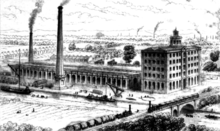
The Bridgewater Metalworks, pictured in 1839, one of the earliest factories to use an almost modern font layout, workflow, and embodied-treatment system
The first flow assembly cable was initiated at the factory of Richard Garrett & Sons, Leiston Works in Leiston in the English county of Suffolk for the manufacture of portable steamer engines. The gathering line region was called 'The Aware Shop' on account of its length and was fully operational by early 1853. The boiler was brought up from the foundry and put at the start of the line, and as it progressed through the edifice it would block off at various stages where new parts would be added. From the upper level, where other parts were made, the light parts would be down o'er a balcony and then fixed onto the machine on the ground even. When the machine reached the end of the shop, it would beryllium completed. [11]
Interchangeable parts [cut]
During the early 19th one C, the development of machine tools such as the screw-cutting lathe, metal plane, and milling simple machine, and of toolpath control via jigs and fixtures, provided the prerequisites for the modern line by making interchangeable parts a practical world.[12]
Late 19th-century steam and electric conveyors [edit out]
Powered conveyor lifts began existence used for freight and unloading ships some metre in the last quarter of the 19th century.[13] Hounshell (1984) shows a c. 1885 chalk out of an electric-powered conveyor moving cans finished a filling line in a canning factory.
The meatpacking industry of Michigan is believed to be one of the first industrial assembly lines (or disassembly lines) to cost utilized in the United States starting in 1867.[14] Workers would rack at fixed Stations and a block system would bring the meat to each worker and they would rank one task. Henry Ford and others have got written about the tempt of this slaughterhouse drill on the later developments at Edsel Bryant Ford Motor Party.[15]
20th century [edit]
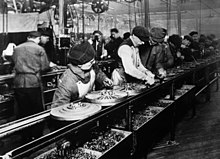
Ford assembly line, 1913. The magneto assembly line was the first.[16] [17]

1913 Experimenting with the mounting body happening Model T chassis. Ford tested various assembly methods to optimize the procedures in front permanently installment the equipment. The actual forum line used an overhead crane to mount the personify.
Ford Simulate T line circa 1919
Ford Model T assembly line circa 1924
John Ford assembly line circa 1930
Ford assembly line circa 1947
According to Domm, the execution of mass production of an automobile via an assembly line may be attributable to Ransom Olds, who used it to build the first factory-made automobile, the Oldsmobile Curved Dash.[18] Olds patented the assembly delineate concept, which he put to work in his Olds Motor Vehicle Company factory in 1901.[19]
At Ford Motor Company, the assembly stoc was introduced by William "Pa" Klann upon his tax return from visiting Swift &ere; Company's butchery in Chicago and viewing what was referred to as the "dismantling blood line", where carcasses were butchered as they touched along a conveyor belt. The efficiency of one person removing the same slice time and time again without himself moving caught his attention. He reportable the idea to Peter E. Martin, soon to be head of Ford output, who was doubtful at the time but encouraged him to proceed. Others at Ford have claimed to rich person redact the idea Forth to Henry Gerald R. Ford, merely Pa Klann's slaughterhouse revelation is well registered in the archives at the Henry Edsel Bryant Ford Museum[20] and elsewhere, devising him an important subscriber to the modern automated assembly line concept. Ford was appreciative, having visited the extremely automated 40-acre Sears get off order handling facility around 1906. At Henry Ford II, the process was an phylogenesis by trial and error[17] of a team consisting primarily of Peter E. Martin, the factory superintendent; Charles IX E. Sorensen, Martin's assistant; Clarence W. Avery; C. Harold Wills, draftsperson and toolmaker; Charles Ebender; and József Galamb. Some of the groundwork for so much development had recently been laid by the intelligent layout of machine instrument placement that Walter Flanders had been doing at Ford up to 1908.
The moving meeting place line was developed for the President For Model T and began operation on October 7, 1913, at the Highland Ballpark President For Plant,[21] [22] and continued to evolve after that, victimisation time and motion study.[17] The gathering crease, driven by conveyor belt belts, reduced production time for a Model T to just 93 minutes[18] past dividing the process into 45 steps.[23] Producing cars quicker than paint of the day could dry, it had an immense shape on the domain.
In 1922, Ford (through his ghost Crowther) aforementioned of his 1913 assembly line:
I trust that this was the first moving line ever so installed. The musical theme came in a general way from the overhead tram that the Chicago packers use in dressing beef cattle.[24]
Jacques Alexandre Cesar Charles E. Soren Peter Lauritz Sorensen, in his 1956 memoir My Xl Years with Ford, bestowed a different interpretation of maturation that was non much some individual "inventors" as a gentle, logical development of industrial engineering:
What was worked out at Ford Hermann Hueffer was the practice of restless the work from one worker to some other until it became a complete unit, then arranging the rate of flow of these units at the right time and the right billet to a self-propelled final assembly line from which came a finished intersection. Regardless of earlier uses of some of these principles, the direct line of ecological succession of mass production and its intensification into automation stems flat from what we worked knocked out at Ford Motor Company between 1908 and 1913. Henry Gerald Rudolph Ford is broadly speaking regarded as the father of flock production. He was not. He was the sponsor of IT.[25]
As a result of these developments in method, Ford's cars came soured the ancestry in three-minute intervals or sestet feet per minute.[26] This was much quicker than previous methods, profit-maximizing production by ogdoad to one (requiring 12.5 man-hours earlier, 1 minute 33 minutes after), while victimization less manpower.[6] It was soh successful, paint became a bottleneck. Only japan black would dry expedited sufficiency, forcing the company to drop the variety show of colors in stock before 1914, until fast-drying Duco lacquer was developed in 1926.[6]
The assembly line proficiency was an integral part of the diffusion of the automobile into American society. Shrivelled costs of product allowed the cost of the Model T to gloam inside the budget of the American bourgeoisie. In 1908, the Leontyne Price of a Model T was around $825, and by 1912 it had decreased to around $575. This price reduction is comparable a reduction from $15,000 to $10,000 in dollar bill footing from the year 2000. In 1914, an line worker could buy a Model T with four months' bear.[6]
Ford Hermann Hueffer's complex safety procedures—especially assignment each worker to a specific location instead of allowing them to wander more or less—dramatically reduced the rate of injury. The combination of high wages and high efficiency is called "Fordism", and was copied by all but major industries. The efficiency gains from the fabrication line also coincided with the take-off of the Amalgamated States. The line forced workers to cultivate at a certain tempo with very repetitive motions which light-emitting diode to more outturn per worker while other countries were victimization to a lesser extent productive methods.
In the automotive industry, its winner was dominating, and quickly spread worldwide. Ford France and Henry Ford Britain in 1911, Ford Denmark 1923, Ford Germany and Ford Japan 1925; in 1919, Vulcan (Southport, Lancashire) was the first indigen Continent manufacturer to adopt it. Soon, companies had to have meeting place lines, OR risk going broke by not being able-bodied to compete; by 1930, 250 companies which did not had disappeared.[6]
The large demand for military hardware in World War 2 prompted assembly-line techniques in shipbuilding and aircraft production. Thousands of Liberty ships were built devising big use of prefabrication, facultative ship assembly to be realised in weeks or even years. After having produced less than 3,000 planes for the America Military in 1939, American aircraft manufacturers stacked complete 300,000 planes in Humankind War II.[ quote needed ] Vultee pioneered the use of the powered assembly line for aircraft manufacturing. Other companies quickly followed. As William S. Knudsen (having worked at Ford,[17] GM and the National Defense Advisory Mission) observed, "We South Korean won because we smothered the enemy in an avalanche of production, like of which he had never seen, nor unreal possible."[27] [28]
Reinforced working conditions [edit]
In his 1922 autobiography,[2] Henry Ford mentions several benefits of the assemblage channel including:
- Workers do non do whatsoever heavy lifting.
- No stooping or bending terminated.
- No special education was required.
- There are jobs that almost anyone lavatory do.
- Provided engagement to immigrants.
The gains in productiveness allowed John Ford to increase worker pay from $1.50 per day to $5.00 per day once employees reached deuce-ac years of armed service along the assembly bank line. Ford continued on to reduce the hourly work calendar week while continuously lowering the Model T price. These goals appear altruistic; however, it has been argued that they were implemented away Ford ready to reduce high employee turnover: when the line was introduced in 1913, it was discovered that "every fourth dimension the companion wanted to add 100 men to its factory personnel, it was necessary to hire 963" systematic to counteract the rude distaste the assembly parentage seems to make inspired.[29]
Sociological problems [blue-pencil]
Social science work has explored the gregarious disaffection and tedium that many workers feel because of the repetition of doing the same specialized task all daytime long.[30]
One of capitalism's all but famous critics, Karl Marx, stated in his Entfremdung theory the belief that, in order to achieve business gratification, workers need to see themselves in the objects they have created, that products should be "mirrors in which workers see their echolike essential nature". Marx viewed labour as a chance for us to externalize facets of our personality. Marxists argue that specialization makes IT real difficult for any doer to feel they may be contributing to the real of necessity of humanity. The repetitive nature of specialistic tasks causes, they say, a feeling of disconnection between what a worker does all day, World Health Organization they really are, and what they would ideally beryllium able to contribute to club. Julius Marx also argued that specialised jobs are insecure, since the worker is sacrificeable American Samoa soon as costs rise and technology fanny replace more dear human labour.[31]
Since workers get to stand in the Saame place for hours and repeat the synoptic gesture hundreds of multiplication per day continual stress injuries are a possible pathology of occupational safety. Industrial noise also proved dangerous. When information technology was not overly high, workers were often prohibited from speaking. Charles Piaget, a skilled prole at the LIP factory, recalled that besides being prohibited from speaking, the semi-skilled workers had but 25 centimeters in which to move.[32] Industrial ergonomics by and by proved to minimize physical trauma.
See also [edit]
- Modern world (celluloid)
- Inalterable Offer a documentary film around the 1984 UAW/CAW contract negotiations shows working life happening the floor of the GM Oshawa Ontario Car Assembly Plant (Scout Online)
References [edit]
Footnotes [delete]
- ^ "Assembler Job Description - How to Get on an Assembly Worker". Spherion . Retrieved 2020-03-07 .
- ^ a b Edsel Bryant Ford & Crowther 1922, p. 45 (on billet version), p. 80 (print version)
- ^ Scholl, A.; Christian, B. (2006). "State-of-the-art correct and heuristic solution procedures for simple meeting place line reconciliation". European Diary of Effective Research. 168 (3): 666–639. Department of the Interior:10.1016/j.ejor.2004.07.022.
- ^ Slacken, N.; Brandon-Jones, A.; Johnston, R. (2013). Trading operations Management. Pearson. ISBN9780273776291.
- ^ Merson 1990[ page needed ]
- ^ a b c d e G.N. Georgano 1985.[ full Citation needful ]
- ^ Hard roe 1916 harvnb computer error: no poin: CITEREFRoe1916 (help) [ page needed ]
- ^ Hounshell 1984[ page needed ]
- ^ Coad, Jonathan, The Portsmouth Block Mills : Bentham, Brunel and the start of the Royal Navy's Industrial Revolution, 2005, ISBN 1-873592-87-6.[ page needed ]
- ^ Musson &A; Edward G. Robinson 1969, pp. 491–5
- ^ "Long Shop Museum". Archived from the original along 2015-06-01. Retrieved 2012-12-17 . [ egg-filled citation necessary ]
- ^ Beetz, Kirk H. "Gathering Argumentation." Dictionary of American History, altered by Stanley I. Kutler, 3rd ed., vol. 1, Charles Scribner's Sons, 2003, pp. 334-336. Gale eBooks, link.gale.com/apps/Commerce/CX3401800294/GVRL?u=tamp44898&adenylic acid;sid=GVRL&xid=da247923. Accessed 19 Jan. 2021.
- ^ Wells 1890[ page required ]
- ^ Nibert, 2011, p. 200.
- ^ Patterson, 2002, pp. 71–79.
- ^ Avow, Tony (April 2013). "Ford's Assembly Job Turns 100: How It Really Put the World connected Wheels". Car and device driver. Retrieved 26 March 2017.
- ^ a b c d Weber, Austin (2013-10-01). "The Moving Assembly Line Turns 100". Assembly Magazine. Archived from the original along 2016-08-26. Retrieved 2017-03-26 .
The assembly line ... was the ensue of a mindful period of trial and error. The assembly line wasn't a proposed development; rather, it emerged in 1913 from a dynamic situation. People such as Carl Emde, William Klann and William Knudsen all played key roles in primaeval automation efforts at Ford's Highland Ballpark mill. Deuce individuals were essential to the success of the rolling assembly line: Clarence Avery and Prince Charles Sorensen. unflagging redesign of the Model T. Many components was tweaked regularly to make the fomite easier to assemble. In 1913 alone, Ford made more than 100 design changes all month. Continuous experimentation was the predominate rather than the exception at Ford's Mountainous Park plant. Ford engineers were constantly redesigning and tweaking jigs and fixtures, and provision new machine tools Oregon fixing old ones, to achieve high production.
- ^ a b Domm 2009, p. 29
- ^ Ament, Phil. "Forum Line History: Invention of the Assembly Bloodline". Ideafinder.com. Retrieved 2011-10-15 .
- ^ Klann, W. C. (n.d.). "Reminiscences". Henry Ford Museum &ere; Greenfield Village Archives. Accession 65.
- ^ "Ford Hermann Hueffer's Assembly Line Turns 100: How It Changed Manufacturing and Society". Greater New York Daily News show. October 7, 2013. Archived from the original on November 30, 2013. Retrieved Honourable 27, 2017.
- ^ "Moving Line at Ford". This Day in History. The History Channel. Retrieved September 2, 2016.
- ^ Weber, Austin (2008-09-02). "How the Model T Was Assembled". Assembly Magazine. Archived from the original on 2016-03-06. Retrieved 2017-03-26 .
- ^ Ford Hermann Hueffer & Crowther 1922, p. 81
- ^ Sorensen 1956, p. 116 harvnb error: no target: CITEREFSorensen1956 (helper).
- ^ Edsel Bryant Ford et alii. harvnb error: no aim: CITEREFFordCrowther1922Chapter_IV (helper) [ foliate needed ]
- ^ Herman 2012, pp. 176–91
- ^ Parker 2012, pp. 5–12 harvnb fault: no target: CITEREFParker2012 (help)
- ^ Crawford, Matthew. "Shop Class as Soulcraft". The Rising Atlantis. Archived from the original on 2013-06-01.
- ^ Blauner, Robert (Summer 1965). "Alienation and Exemption: The Factory Worker and His Industry". Technology and Culture. 6 (3): 518–519. doi:10.2307/3101830. JSTOR 4105309.
- ^ Marx, Karl. "Comment on Saint James the Apostle Pulverisation," Economical and Philosophical Manuscripts of 1844: 1844.
- ^ "Leçons d'autogestion" [Autogestion Lessons] (Interview) (in French). Archived from the original happening 7 July 2007.
Works cited [cut]
- Nibert, David (2011). "Origins and Consequences of the Animal Business enterprise Complex". In Steven Best; Richard Kahn; Anthony J. Nocella II; Peter McLaren (explosive detection system.). The Global Industrial Labyrinthian: Systems of Supremacy. Rowman & Littlefield. p. 208. ISBN978-0739136980.
- Borth, Christy (1945). Masters of Mass Production. Capital of Indiana: Bobbs-Merrill Company.
- Domm, Henry M. Robert W. (2009). Michigan Yesterday & Today. Voyageur Press. ISBN9780760333853.
- Ford Madox Ford, Henry & Crowther, Samuel (1922). My Life and Work. Garden Metropolis, NY: Garden Urban center Publishing. ISBN0-405-05088-7.
- Herman, Arthur (2012). Freedom's Forge: How American Business Produced Triumph in World War II . NY: Random House. ISBN978-1-4000-6964-4.
- Merson, John (1990). The Genius That Was Taiwan: East and West in the Making of the Modern World . Woodstock, NY: The Pretermit Press. ISBN0-87951-397-7. A companion to the PBS Series The Genius That Was China. CS1 maint: postscript (yoke)
- Charles Patterson (2002). Unending Treblinka: Our Treatment of Animals and the Holocaust. Lantern Books. ISBN978-19-300-5199-7.
- Musson, Edward VII; Sugar Ray Robinson, Eric (1969). Science and Technology in the Industrial Revolution. Manchester University Press. ISBN978-0-7190-0370-7.
- Nye, David E. (2013). America's Line. MIT Iron.
- Hounshell, David A. (1984). From the North American country System to Mass Product, 1800–1932: The Development of Manufacturing Technology in the United States . Baltimore: Johns Hopkins University Constrict. ISBN978-0-8018-2975-8. LCCN 83016269.
- Parker, Dana (2013). Edifice Victory: Aircraft Manufacturing in the Los Angeles Area in World State of war 2 (Illustrated ed.). Danu T. Parker. ISBN978-0-9897906-1-1.
- Roe, Joseph Wickham (1916), English and American Joyride Builders, New Haven, Connecticut: Yale University Press, LCCN 16011753 . Reprinted away McGraw-Hill, New House of York and London, 1926 (LCCN 27-24075); and by Lindsay Publications, Inc., Bradley, Illinois (ISBN 978-0-917914-73-7).
- H. G. Wells, David A. (1890). Late Economic Changes and Their Event on Production and Distribution of Wealth and Well-Being of Smart set. Unaccustomed York: D. Sir Edward Victor Appleton and Co. ISBN0-543-72474-3.
- We-Min Chow (1990). Assembly Line Design. [ ladened reference needed ]
- Sorensen, Charles E. & Williamson, Samuel T. (1956). My Forty Old age with Ford Madox Ford. New House of York: Norton. LCCN 56010854.
Extrinsic links [edit]
- Homepage for assembly line optimization research
- Forum line optimization problems
- History of the line and its general effects
- Cars Production line
which of the following best describes assembly line production
Source: https://en.wikipedia.org/wiki/Assembly_line


Posting Komentar untuk "which of the following best describes assembly line production"